

Couples Therapy Florida
Couples Therapy Florida, Couples Counseling In Florida, and finding a qualified Couples Therapist Florida provider are ways married and unmarried partners can explore professional support for communication, trust, conflict, and relationship decisions.
Connect with appropriately licensed professionals, including Florida Licensed Mental Health Counselors (LMHCs) trained to work with couples. Availability and suitability are confirmed before care begins.
The free consultation is an opportunity to discuss options; it is not a therapy session or a guaranteed appointment.
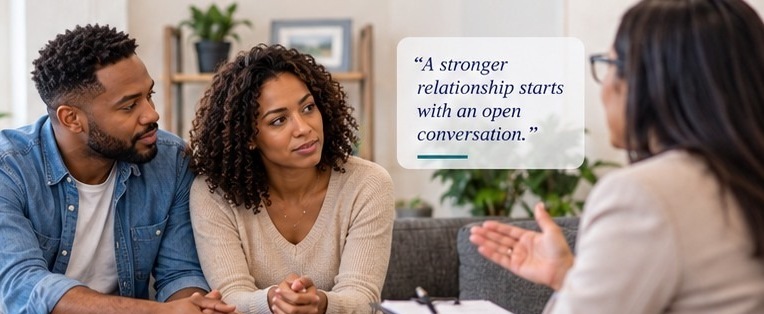
Find a Better Way Forward, Together
Relationship concerns can arise at any stage. A qualified clinician can help partners explore recurring patterns and decide on constructive next steps. The following areas are common reasons couples request help.

Communication & conflict
Practice clearer communication and understand repeated disagreements.
Trust & emotional connection
Explore trust, repair, and feeling heard in your relationship.

Life transitions & shared goals
Navigate parenting, finances, relocation, and changing priorities.

Online couples counseling
Discuss remote sessions with a qualified Florida clinician.

Reconnection & closeness
Talk about emotional distance, affection, and relationship needs.

Healthy relationship skills
Build tools for listening, boundaries, and respectful decisions.
Florida law recognizes counseling to couples under § 491.003; professional title and promotional-material requirements appear in § 491.012 and § 491.0149. Each provider must use their actual license designation.
Find Out Whether Couples Counseling Is Right for You
Request a no-cost introductory conversation about available Florida counseling options.
How Couples Counseling In Florida Works
1. Ask for a consultation
Share general scheduling and service preferences. Avoid sending sensitive relationship details through ordinary contact forms.
2. Confirm provider fit
Ask about the clinician’s active license, couples training, availability, privacy policies, and whether both partners can receive telehealth services at their locations.
3. Discuss goals together
If therapy is appropriate, the clinician can explain consent, confidentiality, safety screening, fees, and a tailored approach to counseling.
Estimated Couples in Florida’s 50 Largest Cities
These are Florida’s 50 largest incorporated cities, ordered by 2024 estimated population. The couple figures are illustrative estimates, not official counts: for planning purposes we assume 40% of residents are in two-person romantic partnerships, so estimated couples equal 20% of the city population (rounded). Actual married and unmarried couple counts may differ substantially. These estimates do not indicate demand for therapy or therapist availability.
City population source: Florida Estimates of Population 2024, Table 9 (page 33). Telehealth eligibility depends on where each client is physically located, provider authorization, and clinical suitability.
Florida Couples Relationship Check-In
Each partner answers eight questions independently on a 1–5 scale. Compare your perspectives only when both people feel safe and comfortable. This educational exercise is not a clinical assessment or diagnosis.
Privacy: Your answers are processed only in your browser; they are not transmitted to or saved by WordPress. Do not complete this exercise together if either person feels pressured or unsafe.
Safety notice: This relationship check-in is educational, not a diagnostic instrument or a substitute for a licensed clinician’s evaluation. If abuse, intimidation, or coercive control is present, seek individualized safety-focused support rather than a joint exercise. In immediate danger, call 911; the National Domestic Violence Hotline is 800-799-SAFE.
Person 1
Person 2
Explore Related Counseling and Mental Health Guides
12 Questions About Couples Therapy Florida
Can a Florida LMHC provide couples therapy?
Florida law permits appropriately trained Licensed Mental Health Counselors (LMHCs) to provide mental health counseling to couples. Ask about the clinician’s experience with couples and relationship concerns.
Do partners need to be married?
No. Couples counseling may be appropriate for married, engaged, dating, and other unmarried partners.
What is the difference between couples counseling and marriage counseling?
The terms can describe overlapping relationship-focused services. The clinician’s actual professional license and training should be clearly identified.
Can couples counseling in Florida be provided online?
Some qualified clinicians offer telehealth. Eligibility depends on the clinician’s authorization to practice where each partner is physically located during the session.
How can I find a couples therapist in Florida?
Request a consultation, confirm the clinician’s active Florida license, and ask about couples-specific training, availability, fees, and telehealth eligibility.
How long does couples therapy take?
Session frequency and duration vary with individual goals, clinical needs, and the therapist’s recommendations. Results are not guaranteed.
Can therapy help communication problems?
Couples may explore listening, communication patterns, emotional regulation, and respectful ways to address disagreements.
Can couples therapy help after infidelity?
A qualified clinician may help partners explore trust, accountability, boundaries, and decisions about the relationship. Repair is not guaranteed.
What happens during the first appointment?
A clinician may review the relationship concerns, goals, privacy and confidentiality, informed consent, and whether joint counseling is clinically appropriate.
Does insurance cover couples counseling in Florida?
Coverage depends on the plan and clinical circumstances. Some relationship counseling is not covered; ask about eligibility, insurance verification, and cash-pay options.
Is the relationship survey private?
The check-in runs locally in your browser and does not submit answers to the website. It is educational and not a diagnosis or clinical assessment.
What if the relationship involves intimidation or abuse?
Joint counseling may be inappropriate or unsafe when there is coercion or violence. Seek individual safety-focused support. Call 911 for immediate danger or 800-799-SAFE for the National Domestic Violence Hotline.
Ready to Explore Relationship Support?
Ask about counseling options with a free 15-minute introductory consultation.
Educational information only, not legal or clinical advice. No clinical results, provider availability, or insurance coverage are guaranteed. In an immediate emergency call 911; for mental health crisis support in the U.S., call or text 988.